An environmental consultant identifies which Ontario approval pathway applies to your facility, inventories its air emission and noise sources, calculates or measures their impact, and compares the results with provincial limits. They document the findings in reports such as an ESDM report or Acoustic Assessment Report, recommend controls where limits are exceeded, and support ECA or EASR submissions.
The consultant provides the technical assessment and documentation, while the facility remains responsible for meeting its regulatory obligations. Where submission is required, the consultant helps prepare the documentation in the form expected by the Ministry of the Environment, Conservation and Parks (MECP).
When Does an Ontario Business Need an Air or Noise Compliance Consultant?
Common triggers include:
- Installing a new dust collector, spray booth, oven, boiler or exhaust stack, or a rooftop chiller, compressor or fan that changes the facility’s sound profile
- Expanding production or adding a shift
- Receiving a noise or odour complaint
- Being asked for an ESDM report or Acoustic Assessment Report as part of an approval application
- Holding an existing air ECA and needing to understand how the EASR transition applies
Whether an assessment, approval or registration is needed depends on your activities, sector and eligibility. A consultant’s first job is to answer that for your facility, not to assume it. For a plain-language look at approval triggers, see SONAIR’s guide on whether you need an ECA in Ontario.
What Happens During an Environmental Compliance Consulting Project?

The environmental compliance consulting process typically follows these steps, although the scope and order depend on the facility and applicable regulatory pathway.
- Initial consultation and pathway review. The consultant reviews what you do, what you are changing and what approvals you hold, then identifies whether an ECA, an EASR registration or neither applies.
- Information collection. You provide equipment lists, process descriptions, material and fuel use, operating schedules, stack and vent details, existing approvals and a site plan.
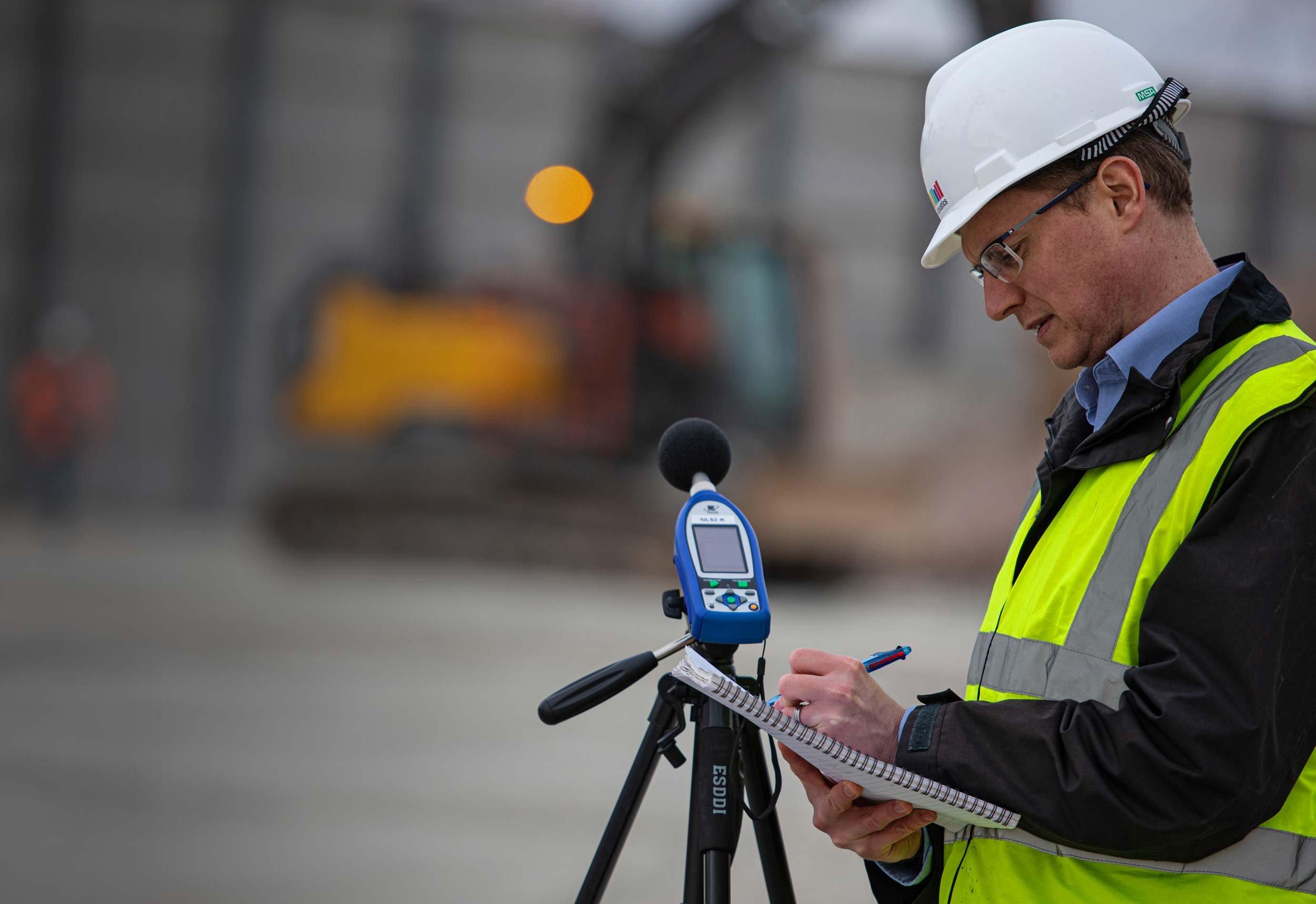
- Site visit and source inventory. The consultant checks the documents against what is installed and identifies and documents relevant emission and noise sources under the applicable assessment requirements, together with sensitive receptors such as nearby homes or schools.
- Air emissions calculations and dispersion modelling. Emission rates are estimated for each source and contaminant, then run through approved dispersion models to predict off-site concentrations.
- Noise screening, measurement or acoustic modelling. Sound data are gathered or measured and used for screening or for a detailed acoustic model, as applicable.
- Comparison with applicable requirements. Predicted concentrations and sound levels are compared with the limits that apply.
- Mitigation recommendations. If results exceed limits, the consultant tests control options in the model before you spend money on them.
- Technical reporting. Results are written up in the format the regulator expects.
- Submission support. Where required, the consultant prepares supporting documents and responds to technical questions.
- Compliance follow-up. The consultant advises on record-keeping and on which future changes would require the assessment to be updated.
At several stages, the consultant must make a practical decision: whether existing approvals cover new equipment; whether screening is sufficient or detailed modelling is needed; whether proposed controls should be assessed before purchase; and whether changes require an amended ECA, EASR registration or updated technical documentation.
A realistic example
A manufacturer adds a dust collector exhaust and a rooftop chiller. The consultant first checks whether the change affects an existing approval or registration, then adds both sources to the inventory using supplier data on airflow, particulate loading and sound power. If the chiller pushes night-time sound levels over the limit at the nearest home, the consultant models a screen, a quieter unit or a changed schedule, and the facility decides which to build. This is an illustration, not a prediction for any specific site.
What Is an ESDM Report, and What Does the Consultant Prepare?

An Emission Summary and Dispersion Modelling (ESDM) report identifies a facility’s air contaminant sources, quantifies their emissions and uses approved dispersion modelling to predict concentrations at applicable points of impingement. The results are compared with Ontario’s limits. It is prepared under Ontario Regulation 419/05 and the ministry’s Guideline A-10 procedure.
Following the A-10 structure, the consultant’s work typically includes:
- Describing the facility, identifying sources and contaminants, and assessing which are significant
- Documenting operating conditions
- Estimating emission rates using stack tests, supplier data, mass balance or published emission factors, and recording data quality
- Preparing the source summary table and site plan
- Running the dispersion model under the ministry’s air dispersion modelling guideline (Guideline A-11)
- Preparing the Emission Summary Table and interpreting the results, including any contaminant that exceeds a limit
An ECA application that includes an ESDM report must also include the signed checklist prescribed in A-10. For facilities registering under the Air Emissions EASR (O. Reg. 1/17), the ministry’s Air Emissions EASR user guide lists an EASR ESDM report and an EASR ESDM report supplement, plus a noise report and an odour screening report. The guide requires the ESDM report and the noise report to be signed and sealed by a licensed engineering practitioner (LEP). SONAIR’s ESDM report service page describes the components in more detail.
What Is an Acoustic Assessment Report in Ontario?
An Acoustic Assessment Report (AAR) is a technical document that predicts sound levels from a facility’s stationary noise sources at nearby sensitive receptors and shows whether they meet the limits in the MECP’s NPC-300 noise guideline. It identifies sources, receptors, the calculation or measurement method and any noise controls needed.
Not every project needs a full AAR. For an ECA application where noise is assessed, the ministry’s ECA guide makes the AAR the default requirement. Primary or secondary noise screening can screen an activity out, subject to eligibility. If it is not screened out, an AAR is required. The ministry may still require one where the facility is an ongoing source of noise complaints, and significant vibration sources such as stamping presses or forging hammers rule out screening and call for a detailed noise and vibration assessment.
For EASR, the noise report must meet one of five criteria under O. Reg. 1/17: noise setback, primary screening, secondary screening, acoustic assessment, or a Noise Abatement Action Plan (NAAP). The NAAP option is restricted to qualifying existing facilities that began operating before January 31, 2017 and exceeded the applicable sound level limit, as demonstrated by an acoustic assessment, when first registering. It is not a general compliance option for new facilities or for any facility that later exceeds noise limits.
In practice, the consultant:
- Lists each stationary noise source with its sound power, operating hours and location
- Identifies the nearest points of reception and classifies the surrounding area
- Selects the applicable limits
- Models propagation or uses measurements for the worst case, and specifies noise controls where limits are not met
The ESDM report and the AAR answer different questions. The first addresses air contaminants at off-site receptors. The second addresses sound at neighbouring points of reception. The ministry’s ECA guide says the AAR should be linked with the ESDM report so that both identify sources consistently. SONAIR’s Acoustic Assessment Report service page and its article on noise impact studies vs acoustic assessment reports cover the difference from a land-use planning noise study.
How Does an Environmental Consultant Support ECA or EASR Compliance?
The consultant prepares the technical documents. The facility is the applicant or registrant, and for an ECA the ministry makes the decision.
The two pathways are not interchangeable:
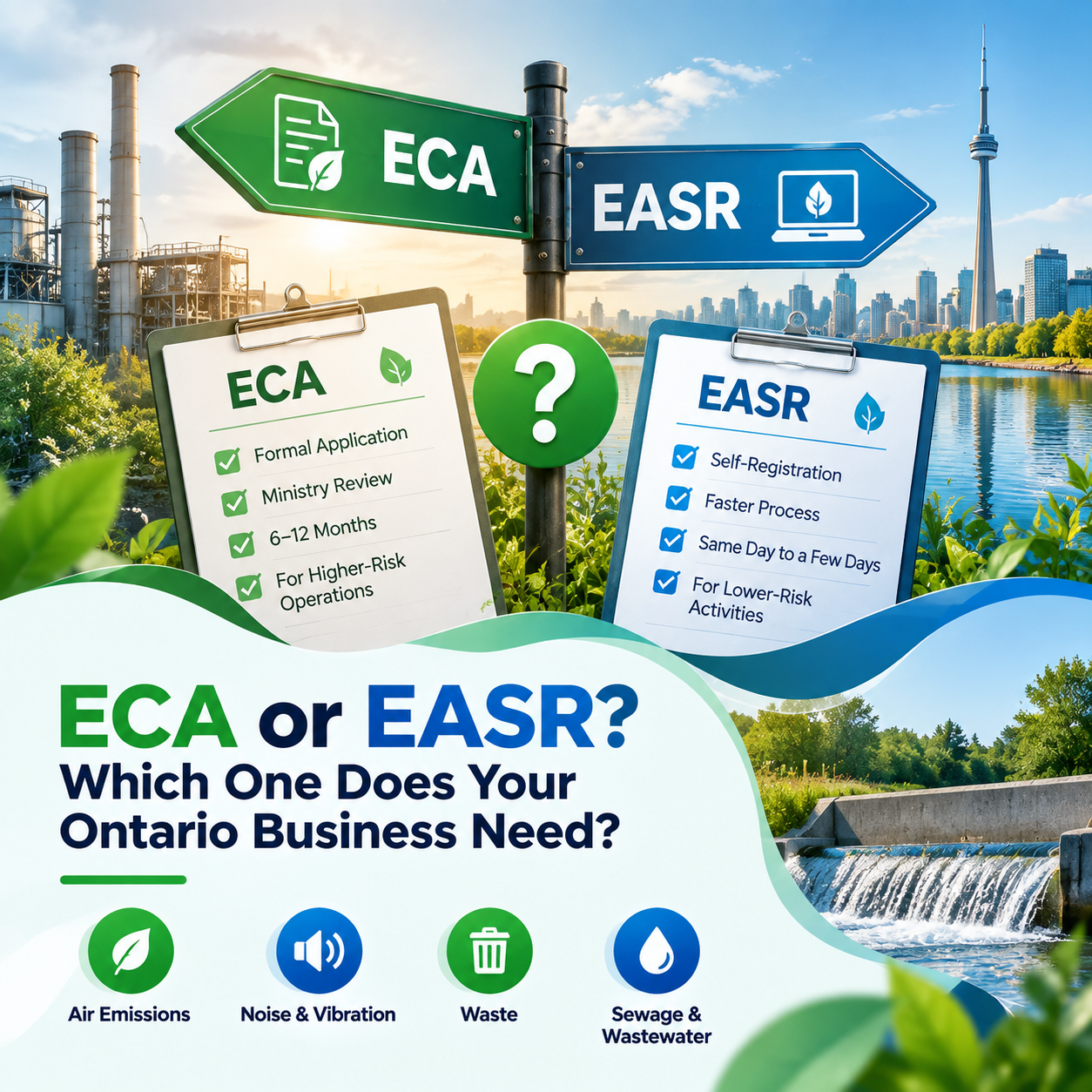
- Environmental Compliance Approval (ECA): a ministry-issued permission. The ministry reviews the application and decides whether to issue it. The consultant helps prepare technical answers to ministry questions.
- Environmental Activity and Sector Registry (EASR): for prescribed activities that meet the regulatory requirements, the facility registers online instead of applying for an ECA. The required reports are prepared first, and the ESDM and noise reports are signed and sealed by an LEP, meaning a person licensed under the Professional Engineers Act.
| Role | Responsibility |
| Consultant | Pathway review, source inventory, modelling, reports, technical responses, mitigation advice |
| Licensed engineering practitioner | Signs and seals the reports the EASR regulation requires; may be the consultant or a member of the consulting team |
| Facility | Accurate data, equipment access, decisions on controls, application or registration, record-keeping, operating within the assessed conditions |
| Regulation | Sets what must be assessed, the limits and the report requirements |
| MECP | Decides ECA applications and sets approval conditions |
- Transition date for existing air ECAs. Ontario’s Air Emissions EASR guidance identifies January 31, 2027, as the transition deadline for prescribed activities operating under an existing ECA, unless a change requiring an ECA amendment triggers earlier registration. In August 2026, the province proposed removing the fixed deadline under ERO notice 026-0775. As of November 19, 2026, ERO 026-0775 remains at the proposal stage; I found no posted decision or enacted amendment removing the deadline. Facilities should check the current text of Ontario Regulation 1/17 and the ERO notice before planning their transition. SONAIR’s ECA and EASR page explains eligibility.
What Happens if an Air or Noise Assessment Identifies a Compliance Problem?
Realistic options include:
- Source controls: better filtration, a taller or relocated stack, or a lower-emitting process
- Process changes: substituting materials or changing batch sizes and temperatures
- Noise controls: enclosures, silencers, barriers, vibration isolation or relocating a unit
- Operational adjustments: moving noisy activities away from night hours or limiting the equipment run at once
- Refined assessment: replacing conservative assumptions with stack test or sound measurement data, which may show a lower real impact
- Action plans: where an AAR shows the facility cannot meet the noise limits, the ECA guide requires a Noise Abatement Action Plan describing when and how compliance will be achieved
Not every exceedance can be fixed on paper. Where a genuine exceedance is confirmed, a suitable compliance response may require physical or operational changes, not just revised documentation.
What Does a Business Receive at the End of the Project?
You receive a defensible record of what the facility emits, how it was assessed and what must be done. The exact set depends on the pathway and the facility.
| Stage | Consultant activities | Typical deliverables |
| Scoping | Pathway review, data request | Scope letter, information checklist |
| Data and site visit | Source inventory, receptor identification | Source summary table, site plan, sound source list |
| Assessment | Emission estimates, dispersion and acoustic modelling | Model inputs and outputs, calculation records |
| Evaluation | Compare to limits, test mitigation | Emission Summary Table, predicted sound levels, control options |
| Reporting | Prepare reports | ESDM report, Acoustic Assessment Report or screening documents |
| Submission | Support ECA application or EASR registration, answer technical questions | Supporting documents, responses |
| Follow-up | Advise on changes | Update triggers, record-keeping guidance |
Your ongoing responsibilities include operating within the assessed conditions, keeping required records, and calling your consultant before changing equipment or processes that could alter emissions or noise.
How Should an Ontario Business Choose an Environmental Compliance Consultant?
Ask for evidence, not slogans:
- Industry experience: Have they worked on facilities with similar processes?
- Technical and Ontario competence: Do they model air and noise using the ministry’s approved methods and know ECA, EASR, NPC-300 and the ESDM procedure?
- Professional qualifications: Who will sign and seal the reports, and what is their licence number? The ministry’s guide requires the LEP’s licence number to appear on EASR noise reports. Professional Engineers Ontario publishes guidance for engineers working under O. Reg. 1/17.
- Reporting quality: Ask for an anonymized sample report structure.
- Scope clarity: What is included, what data you must supply, and what changes the scope?
If you are unsure which assessment applies to a planned change, describe the equipment and site to a consultant before committing to a full study. You can book a consultation with SONAIR to talk through your facility’s situation.
Frequently Asked Questions
Does every Ontario business need an ESDM report?
No. It is needed where your activities and pathway call for one, such as an ECA application involving air emissions or an Air Emissions EASR registration. Some activities need neither, so have your situation checked against current regulations.
Who has to sign and seal the reports?
For the Air Emissions EASR, the ministry’s guide requires the ESDM report and the noise report to be signed and sealed by an LEP. It does not apply that requirement to the ESDM supplement or the odour screening report. Ask your consultant who will sign, and confirm the requirements for your pathway.
Can a consultant help update an existing ECA, and must we move to the EASR?
Yes, the consultant can assess a change and prepare supporting documentation for an amendment. For prescribed activities, the current transition rule still specifies January 31, 2027, or earlier registration following certain changes requiring an ECA amendment. The proposed removal of that deadline has not been confirmed as approved as of November 19, 2026.
What should we prepare before hiring a consultant?
Gather equipment lists, process descriptions, hours of operation, existing ECA or registration documents, a site plan, supplier data sheets for new equipment, and any complaint or inspection history.
Does the consultant submit the application or approve it?
The consultant prepares supporting documents and may help with the submission, but the facility is the applicant or registrant. For an ECA, the ministry decides. For an EASR, the facility registers once the requirements are met and is responsible for that registration.