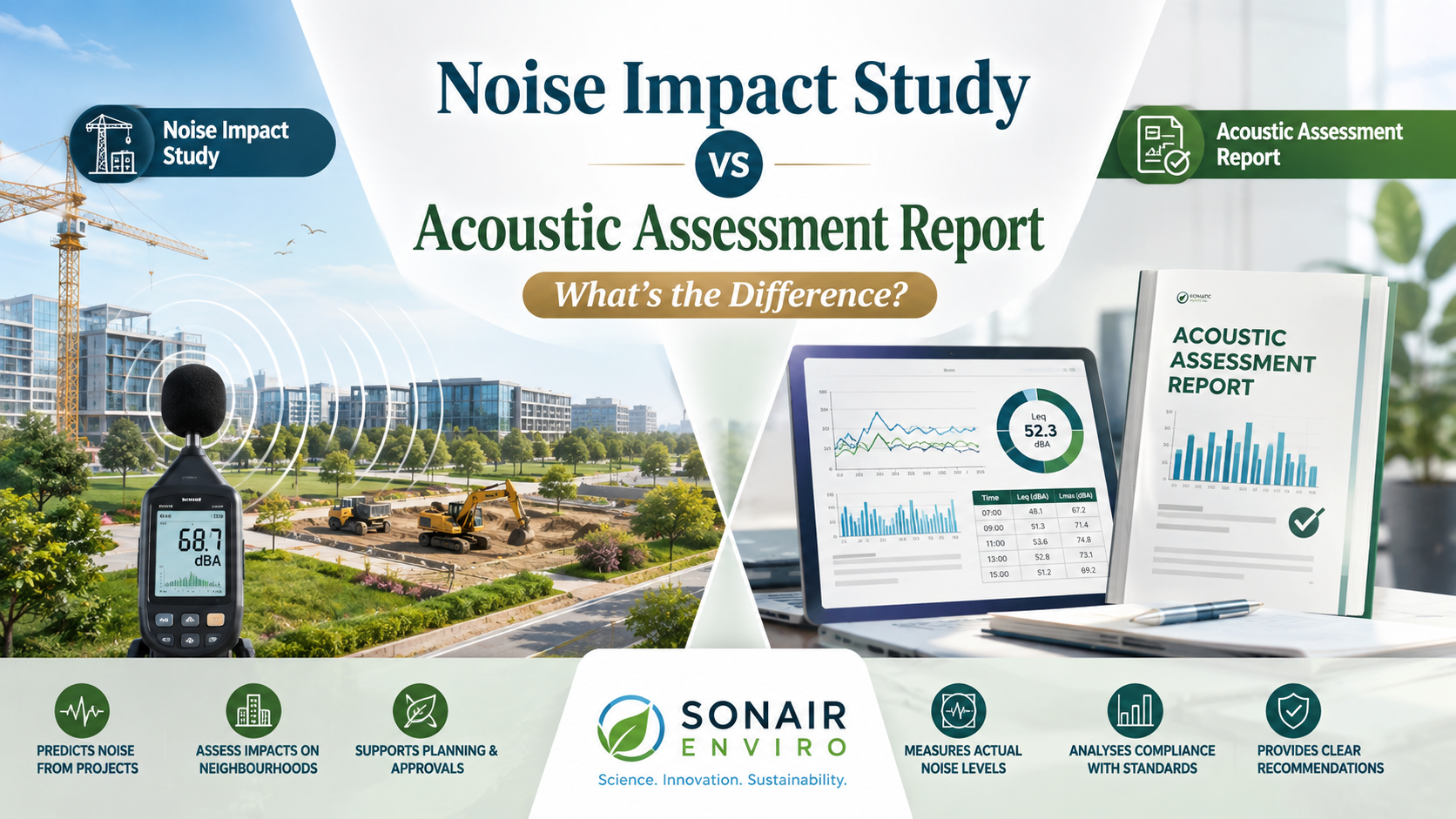
A proposed development can be up to 1,000 metres from a Class III industrial facility and still fall within the potential influence area identified by Ontario’s D-6 land-use compatibility guideline. That distance surprises many owners. The bigger surprise comes later, when a municipality asks for a “noise study” and the project team assumes it means the same thing as an Acoustic Assessment Report.
It does not. In Ontario, the two documents can use similar modelling tools and both may refer to MECP Publication NPC-300, but they usually answer different regulatory questions. Choosing the wrong scope can lead to redesign, extra field work, peer-review comments and approval delays.
The Quick Answer
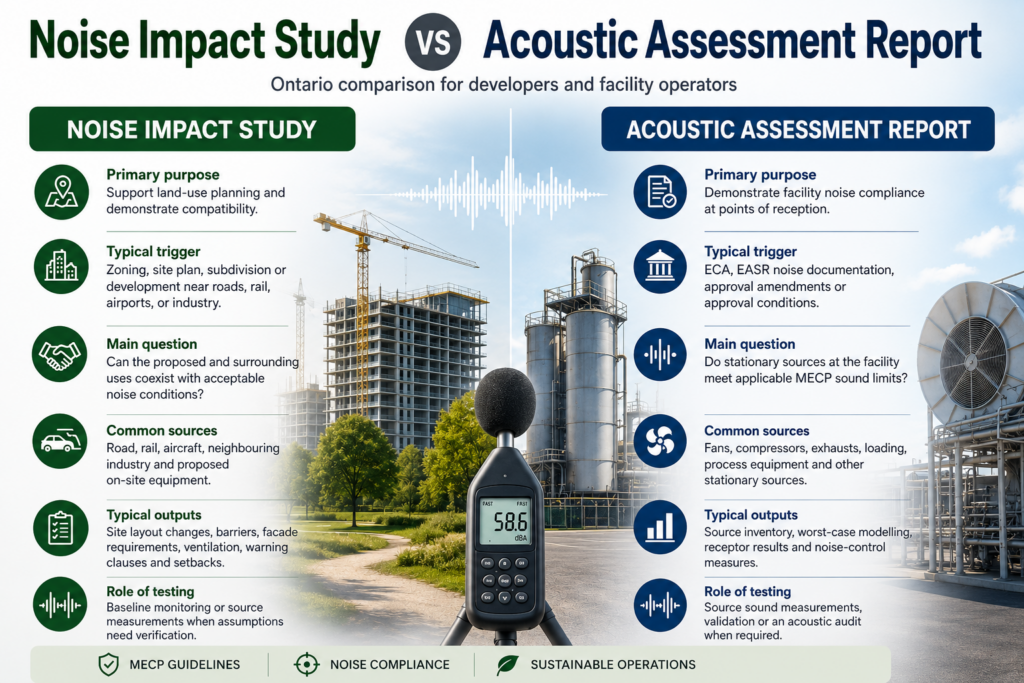
A Noise Impact Study is generally prepared for municipal planning and land-use compatibility. It examines whether a proposed development and nearby noise sources can coexist, then recommends design controls such as setbacks, barriers, upgraded windows, ventilation and warning clauses.
An Acoustic Assessment Report (AAR) is generally a formal facility-compliance document. It assesses stationary sources from an industrial or commercial operation at nearby points of reception and demonstrates whether the facility meets applicable MECP noise limits.
Do not scope the work from the title alone. |
What Is a Noise Impact Study in Ontario?
A noise impact study Ontario planning authority requests is usually tied to a development application. Toronto, for example, identifies Noise Impact Studies as supporting material that may be required for applications such as zoning amendments, site plan control, subdivisions and consents. The exact trigger and scope depend on the municipality and the surrounding land uses.
A planning-focused noise impact assessment may evaluate:
- road, rail or aircraft noise affecting a proposed residential or institutional use;
- stationary noise from nearby industrial or commercial facilities;
- noise generated by the proposed development itself, including rooftop equipment, loading areas or emergency generators;
- whether the site layout creates appropriate separation between sensitive and industrial uses; and
- the mitigation needed to satisfy NPC-300 and municipal requirements.
The final recommendations often shape the development design. A consultant may relocate outdoor amenity space, specify acoustic barriers, require central air conditioning so windows can remain closed, recommend facade components, or add warning clauses to purchase and tenancy agreements.
What Is an Acoustic Assessment Report in Ontario?
An acoustic assessment report Ontario facility operators request is usually connected to environmental compliance rather than land-use approval. It may support an Environmental Compliance Approval, an Environmental Activity and Sector Registry noise report, an amendment, or a condition already written into an approval.
Under Ontario’s EASR framework, a facility may use a Primary Noise Screening Method, a Secondary Noise Screening Method or a detailed acoustic assessment, depending on eligibility and site conditions. An AAR is therefore not automatically required for every operation. It becomes necessary when screening cannot adequately demonstrate compliance or when an approval specifically requires it.
A detailed AAR typically includes:
- an inventory of stationary noise sources and their locations;
- sound data for fans, compressors, exhausts, process equipment, truck activities and other relevant sources;
- the predictable worst-case operating scenario, not merely an average day;
- identification and classification of affected points of reception;
- acoustic modelling and comparison with the applicable NPC-300 limits; and
- noise-control measures, implementation requirements and supporting calculations.
AAR is not the same as an acoustic audit. |
Where Acoustic Noise Testing Fits
Acoustic noise testing is a method, not a substitute name for either report. Both report types may use field measurements, but not every project requires the same testing program.
Testing may be needed to:
- establish the existing background sound environment;
- measure equipment when reliable manufacturer sound data is unavailable;
- separate facility noise from transportation or community sources;
- investigate tonal, impulsive or low-frequency characteristics;
- validate a model or confirm that installed mitigation performs as designed.
A phone app or an inexpensive handheld meter is rarely enough for a defensible regulatory conclusion. In a relevant Reddit discussion, acoustic practitioners emphasized calibrated equipment, measurement training and professional interpretation, especially where results may be challenged. That observation is anecdotal, but it reflects a practical truth: a number without documented conditions, calibration and methodology has limited value.
Two Examples That Show the Difference
Example 1: Residential development beside a highway and factory
A developer proposes apartments near a major road and an operating metal fabricator. The municipality may request a Noise Impact Study or a broader land-use compatibility study. The assessment considers traffic exposure at the new building, stationary industrial noise, outdoor amenity areas and the risk that new residents could constrain the existing business.
Likely recommendations: podium or building orientation changes, barriers, upgraded glazing, ventilation requirements, warning clauses and confirmation that the industrial operation can continue without creating an adverse effect.
Example 2: Manufacturing facility adding rooftop equipment
An existing manufacturer adds exhaust fans and increases evening production. The relevant question is whether the complete facility, under a predictable worst-case operating scenario, complies at nearby residences. The operator may need an AAR or an updated AAR for its ECA or EASR documentation.
Likely recommendations: silencers, acoustic enclosures, revised fan selection, barriers, operating restrictions or relocation of equipment. This is a facility-compliance exercise, even though the modelling software may resemble that used for the planning study.
What Both Reports Should Get Right
Regardless of the document title, a credible noise study Ontario submission should make five items clear:
- Regulatory purpose: identify the approval, application or condition the report supports.
- Receptors: map existing, vacant and proposed noise-sensitive locations correctly.
- Operating assumptions: document hours, equipment loads, truck activity and concurrent operations.
- Source evidence: state whether data comes from measurements, manufacturer information or accepted references.
- Actionable mitigation: provide enough technical detail for the measures to be designed, priced and secured.
Common Scoping Mistakes That Cause Delays
Starting measurements before confirming the approval path: A monitoring program designed for transportation noise may not provide the source data needed for an industrial AAR. Confirm the question first, then design the testing.
Assessing only the loudest-looking equipment: Several moderate sources can combine into the controlling result. The model must include all relevant concurrent sources under the correct operating scenario.
Ignoring future or vacant receptors: A facility may comply at the nearest occupied home but fail at a closer vacant lot with the potential for sensitive use. Receptor selection must follow the applicable guidance.
Treating mitigation as a generic recommendation: “Install a barrier” is not enough. The report should define location, height, extent, density and performance assumptions so the design team can implement it.
Assuming municipal acceptance equals MECP compliance: A planning approval and a facility’s environmental approval are separate processes. One report may inform the other, but neither automatically replaces the other.
Which Report Do You Need?
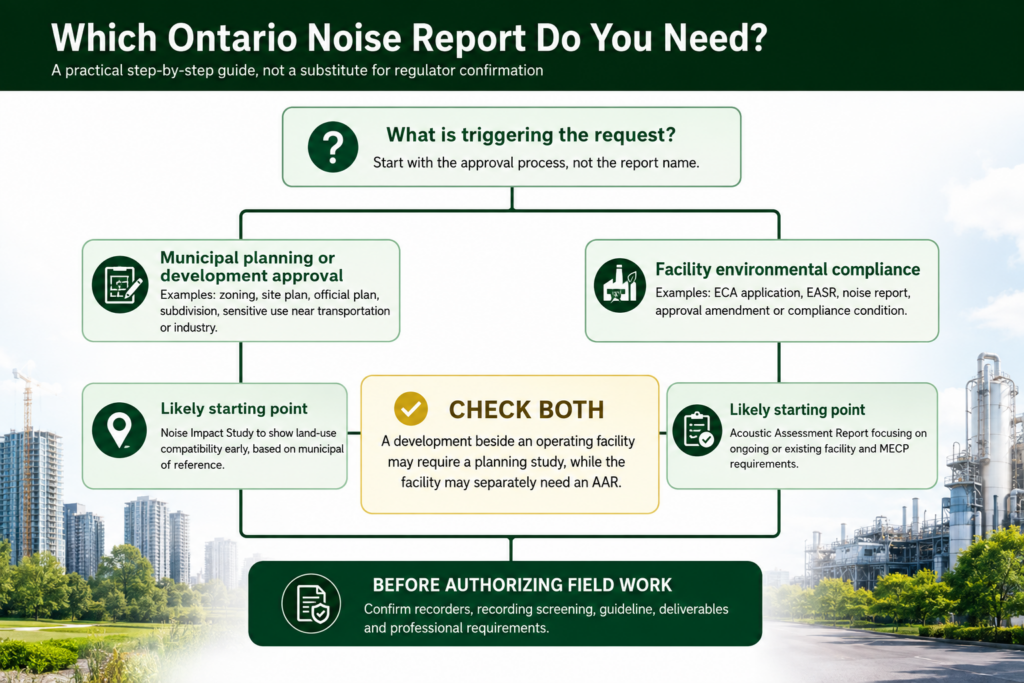
Use the approval trigger as your first filter. A municipal request for a development near transportation or industrial uses usually points toward a Noise Impact Study. A requirement attached to a facility’s ECA, EASR or stationary-source compliance usually points toward noise screening or an Acoustic Assessment Report.
For land-use compatibility support, review SONAIR’s Land Use Compatibility and Air Quality Studies. For facility compliance, see the Acoustic Assessment Report and ECA and EASR in Ontario service pages. Projects involving broader compliance documentation may also require environmental reporting or an Emission Summary and Dispersion Modelling Report.
Get the Right Scope Before You Submit
The costliest mistake is not choosing the wrong report title. It is answering the wrong regulatory question. SONAIR Environmental can review the approval trigger, confirm the applicable Ontario and municipal guidance, define the required acoustic noise testing and prepare a report that the reviewing authority can act on.
Book a consultation with SONAIR Environmental before field work or detailed design begins.