Wastewater approvals in Ontario are a critical regulatory requirement for any business that discharges industrial, commercial, or pre-treated wastewater into municipal systems or the environment.
In most cases, approval is governed by the Environmental Compliance Approval (ECA) system under the Ontario Ministry of the Environment, Conservation and Parks (MECP). For businesses, this is not just paperwork—it determines whether a facility can legally operate.
Understanding how wastewater approvals work, what triggers them, and where delays occur is essential for avoiding compliance risks and project shutdowns.
Ontario Wastewater Approval Process (Real Workflow)
Below is the actual structure used in most MECP submissions:
- Pre-consultation
- Optional but strongly recommended
- Identifies regulatory risks early
- Engineering Design Submission
- Flow diagrams
- Treatment process design
- Contaminant load calculations
- MECP Technical Review
- Confirms compliance with provincial standards
- May request revisions or additional modeling
- Public / Agency Review (if applicable)
- Used for higher-risk or large-scale projects
- Final ECA Issuance
- Legally binding operating conditions are set
Typical Approval Timeline (Ontario Benchmark)
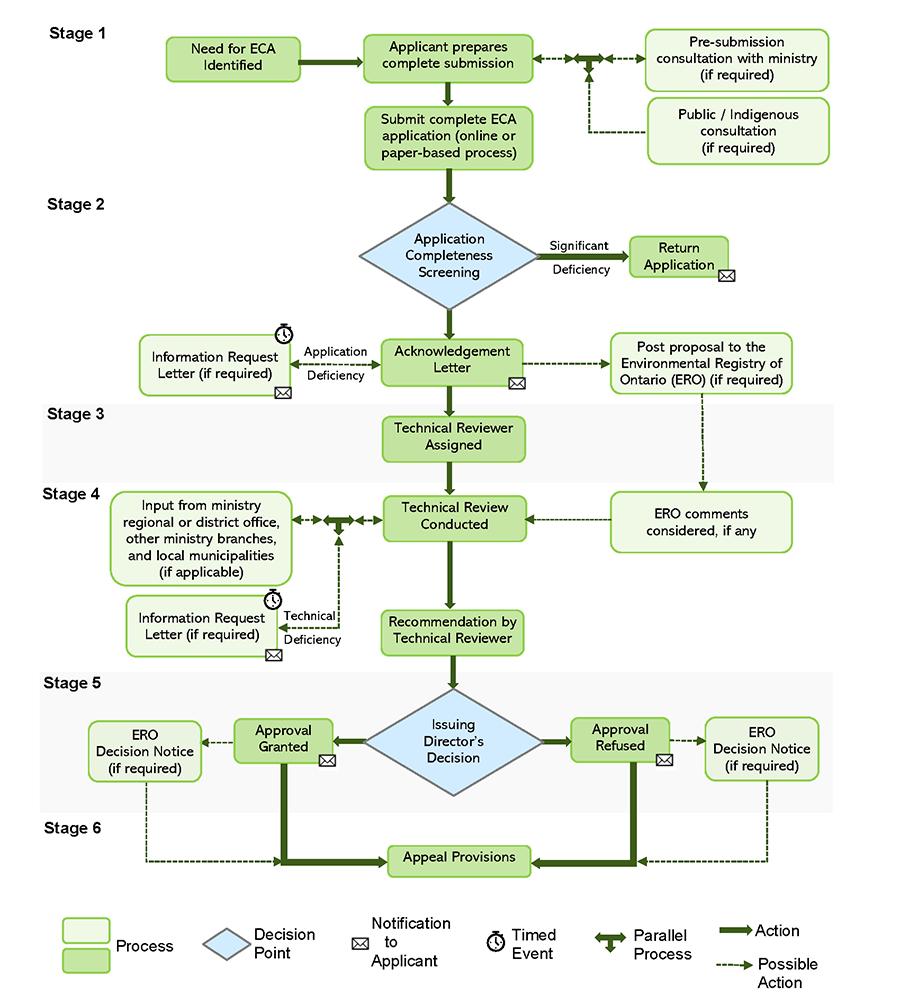
The approval timeline is rarely linear. Engineering complexity and municipal coordination are the biggest delay factors, not paperwork volume alone.
| Stage | Typical Duration | Key Bottleneck |
|---|---|---|
| Pre-Application | ~2 weeks | Missing baseline data |
| Technical Review | ~6 weeks | Design inconsistencies |
| MECP Assessment | ~12 weeks | Load calculations / compliance gaps |
| Agency Review | ~3–4 weeks | External comments |
| Final Approval | ~2–3 weeks | Administrative closure |
Critical insight: most delays occur during MECP technical review, not at submission stage.
Where Ontario Businesses Usually Fail
The failure pattern is surprisingly consistent across industries:
1. Underestimating effluent variability
Wastewater is treated as “stable output,” but regulators expect worst-case discharge scenarios, not averages.
2. Missing load calculations
Many submissions only include flow rate, ignoring chemical loading curves.
3. Poor integration between engineering and operations
Design teams and plant operators often work in silos, causing inconsistent data.
4. Assuming municipal approval is enough
Municipal sewer approval does not replace MECP ECA requirements.
Compliance Risk vs Business Impact
| Risk Area | Operational Impact | Business Consequence |
|---|---|---|
| Unapproved discharge | Immediate enforcement | Fines / shutdown risk |
| ECA breach | Monitoring failure | Mandatory system redesign |
| Overloaded sewer connection | Infrastructure stress | Municipal penalties |
| Poor treatment design | Non-compliance | Capital reinvestment |
Wastewater compliance is not static. Any production change can trigger re-evaluation.
Practical Compliance Checklist
Before submitting any application:
- Confirm full chemical profile of discharge
- Validate peak vs average flow conditions
- Include contingency scenarios in design
- Align engineering and operational data sources
- Verify municipal by-law limits separately from MECP thresholds
- Document all assumptions explicitly
If any of these are missing, the application is structurally incomplete.
Final Perspective
Wastewater approvals in Ontario are not administrative steps, they are engineering validation processes.
The MECP is effectively testing whether your system can safely handle real-world operating conditions without environmental risk.
Businesses that treat wastewater approval as a design-critical stage rather than a paperwork stage consistently achieve:
- Faster approvals
- Fewer redesign cycles
- Lower compliance risk
- More stable long-term operations
For industrial operators, early-stage engineering alignment is the strongest predictor of approval success.