If your business releases anything into the air, generates noise, handles waste, or discharges wastewater, you’ve probably run into the term Environmental Compliance Approval (ECA) — and the question of whether you actually need one.
The short answer: if your operation emits to air, creates noise or vibration, manages waste, or runs sewage or wastewater works, you likely need either an ECA or a related registration called an EASR. Which one depends on how much risk your activity poses. Below, we’ll break down exactly how that decision gets made, what it costs in time, and what happens if you skip it.
What Is an ECA, Exactly?
An ECA is a permission issued by Ontario’s Ministry of the Environment, Conservation and Parks (MECP). It confirms that your facility can operate with environmental controls in place to protect human health and the natural environment. It replaced the old “Certificate of Approval” system in 2011, though older certificates are still treated as ECAs today.
An ECA isn’t one blanket document — it’s typically tied to specific activities at your site, and a single facility can end up needing separate approvals (or one consolidated one) for different sources of impact.
The Three Legal Triggers for an ECA
Ontario’s environmental legislation creates the requirement through three specific sections of law:
- Air, noise, and vibration — Section 9 of the Environmental Protection Act
- Waste — Section 27 of the Environmental Protection Act
- Sewage and wastewater works — Section 53 of the Ontario Water Resources Act
If your business activity falls into any one of these categories, you’re in scope for either an ECA or an EASR registration. It’s worth noting: an existing environmental permit does not automatically transfer with a property sale or lease. If you’re taking over an operation, don’t assume the previous owner’s approval covers you.
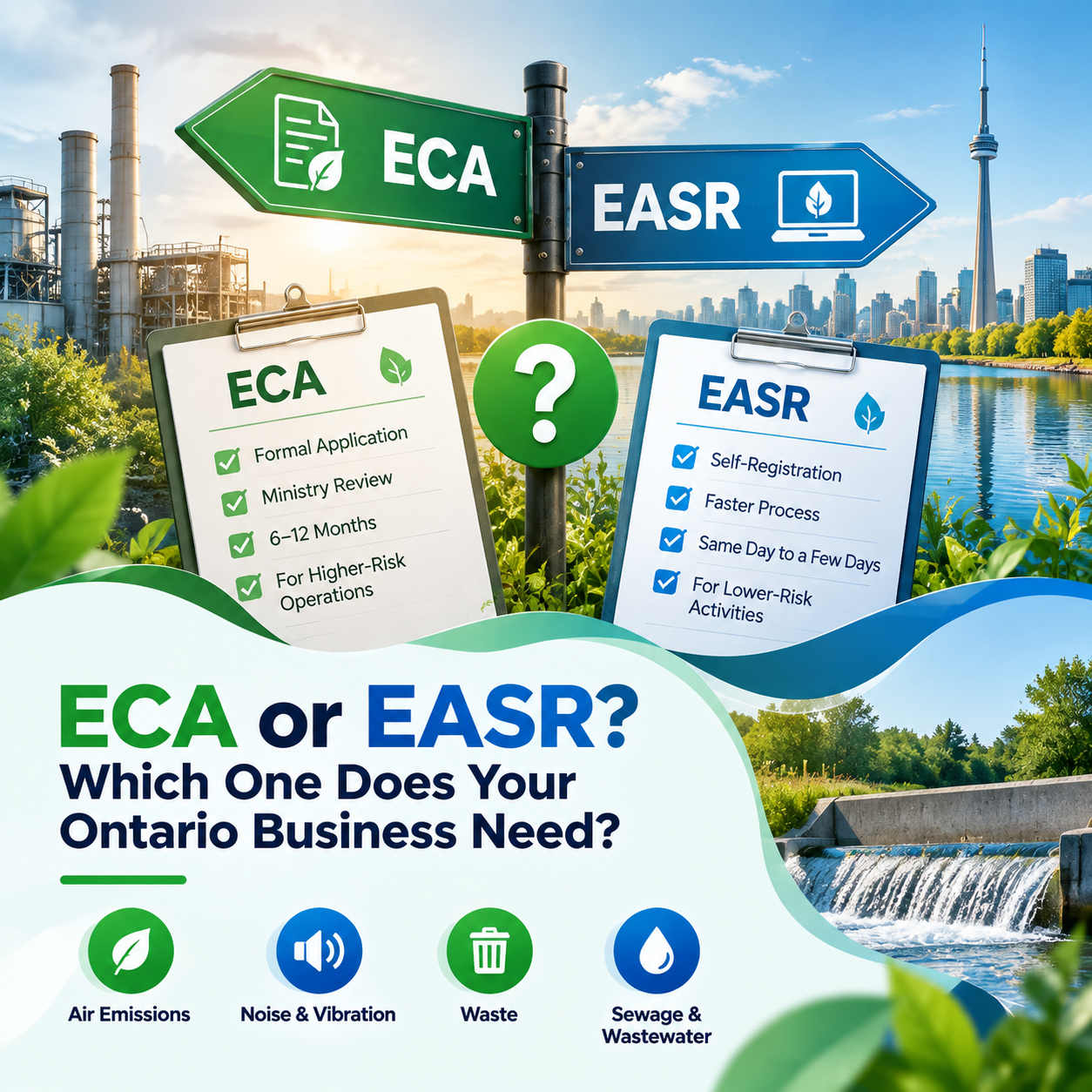
ECA vs. EASR: Which One Applies?
This is where most business owners get tripped up, so it’s worth its own explanation — see our full breakdown of ECA and EASR for the complete comparison. Here’s the short version:
| EASR | ECA | |
| Best for | Lower-risk, well-understood activities | More complex operations with higher potential impact |
| Process | Self-registration through an online system | Formal application reviewed by the MECP |
| Typical timeline | Effective on submission (same day to a few days) | Roughly 6–12 months for standard review |
| Ongoing obligation | Must still meet the sector’s operating requirements | Must comply with the conditions in the approval |
The Environmental Activity and Sector Registry (EASR) exists because a large share of standard commercial and light-industrial activities don’t need the same level of case-by-case scrutiny as a large manufacturing plant or waste facility. Since the program launched, sectors such as automotive refinishing shops, commercial printing facilities, standard heating systems, non-hazardous waste transportation, small ground-mounted solar installations, and standby power systems have qualified for EASR rather than a full ECA. If your activity isn’t on an eligible list, or your emissions are more complex, you’ll need to go the ECA route instead.
How Long Does It Actually Take?
This is usually the first question business owners ask once they realize they’re in scope — and it’s a big part of why planning early matters.
Show Image
An EASR registration takes effect as soon as you submit it correctly — the ministry doesn’t hold up your ability to operate while it reviews the file. An ECA is a different story: because it involves technical review by the ministry, standard applications commonly take somewhere in the 6-to-12-month range, depending on the complexity of your activity, the completeness of your submission, and current ministry workload. Incomplete applications, missing technical reports, or unclear project descriptions are the most common causes of delay.
If your situation involves a genuine health or environmental risk, an infrastructure funding deadline, or an active compliance issue, you can request that your application be prioritized — but that’s the exception, not the rule.
What Happens If You Operate Without One?
This isn’t a hypothetical risk. Ontario enforces this. In one case, a company operating a waste disposal site without an ECA was investigated after a public complaint, found to be burning mixed waste in an unapproved burn pit, and was ultimately fined $7,500 plus a victim surcharge — on top of roughly $50,000 in required cleanup costs. Beyond fines, the ministry can issue orders requiring you to stop the activity or remediate the site, which is often far more disruptive to a business than the approval process itself would have been.
Operating without a required ECA also creates real risk during a property sale, financing, or insurance renewal, since buyers and lenders increasingly ask for proof of environmental compliance before closing.
How to Find Out What Your Business Needs
Before you can answer “do I need an ECA,” you need clarity on what you’re actually emitting, discharging, or generating. A few starting questions:
- Does your process release anything to outdoor air — dust, odour, solvent vapours, combustion exhaust?
- Could a neighbour reasonably hear equipment noise from your property line?
- Do you generate, store, or transport waste, including hazardous waste?
- Does wastewater from your operation go anywhere other than a standard municipal sanitary connection?
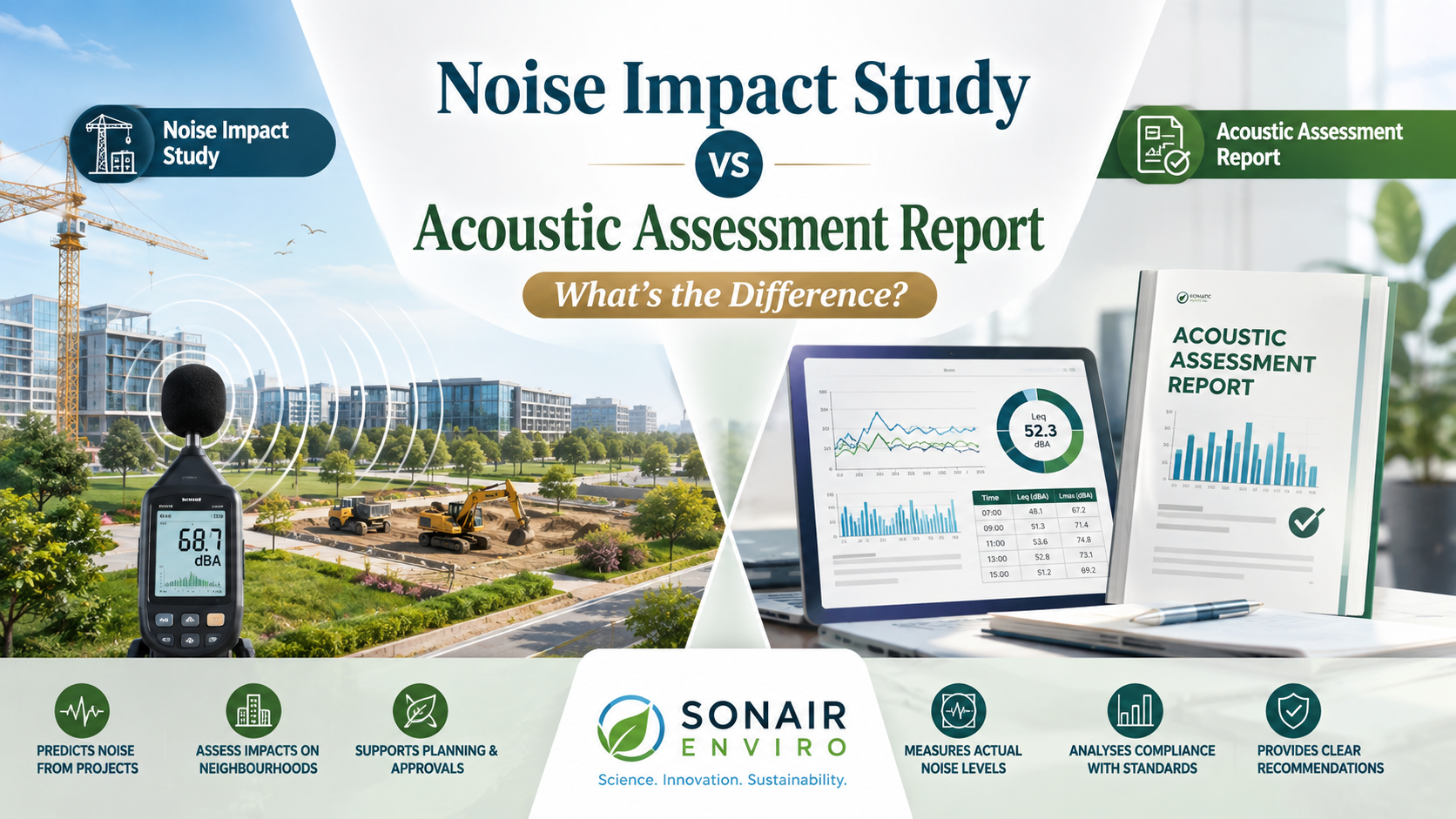
If you answered yes to any of these, it’s worth having a consultant assess your specific activity against the current EASR eligibility lists and ECA requirements — the categories and thresholds do get updated periodically, and getting the classification wrong at the start is far more expensive to fix later than to plan for. Related documentation, like an Emission Summary and Dispersion Modelling (ESDM) report for air applications or an acoustic assessment for noise-sensitive sites, is often required as supporting evidence within the application itself, so it helps to scope that work at the same time.
The Bottom Line
Most Ontario businesses that touch air emissions, noise, waste, or wastewater need some form of environmental approval — the real question is whether that’s a same-day EASR registration or a longer ECA application. Getting an accurate answer early protects your timeline, your budget, and your ability to close deals without last-minute compliance surprises.
Not sure which category your business falls into? Book a consultation with our team, and we’ll walk through your specific activities and tell you exactly what’s required before you invest time in the wrong process.