The short answer: does your shop need environmental approval?
If your auto body shop or small manufacturing facility runs equipment that can release contaminants to the air, such as a paint spray booth, Ontario law generally requires an environmental permission from the Ministry of the Environment, Conservation and Parks (MECP), unless an exemption applies. That permission is not always an Environmental Compliance Approval (ECA).
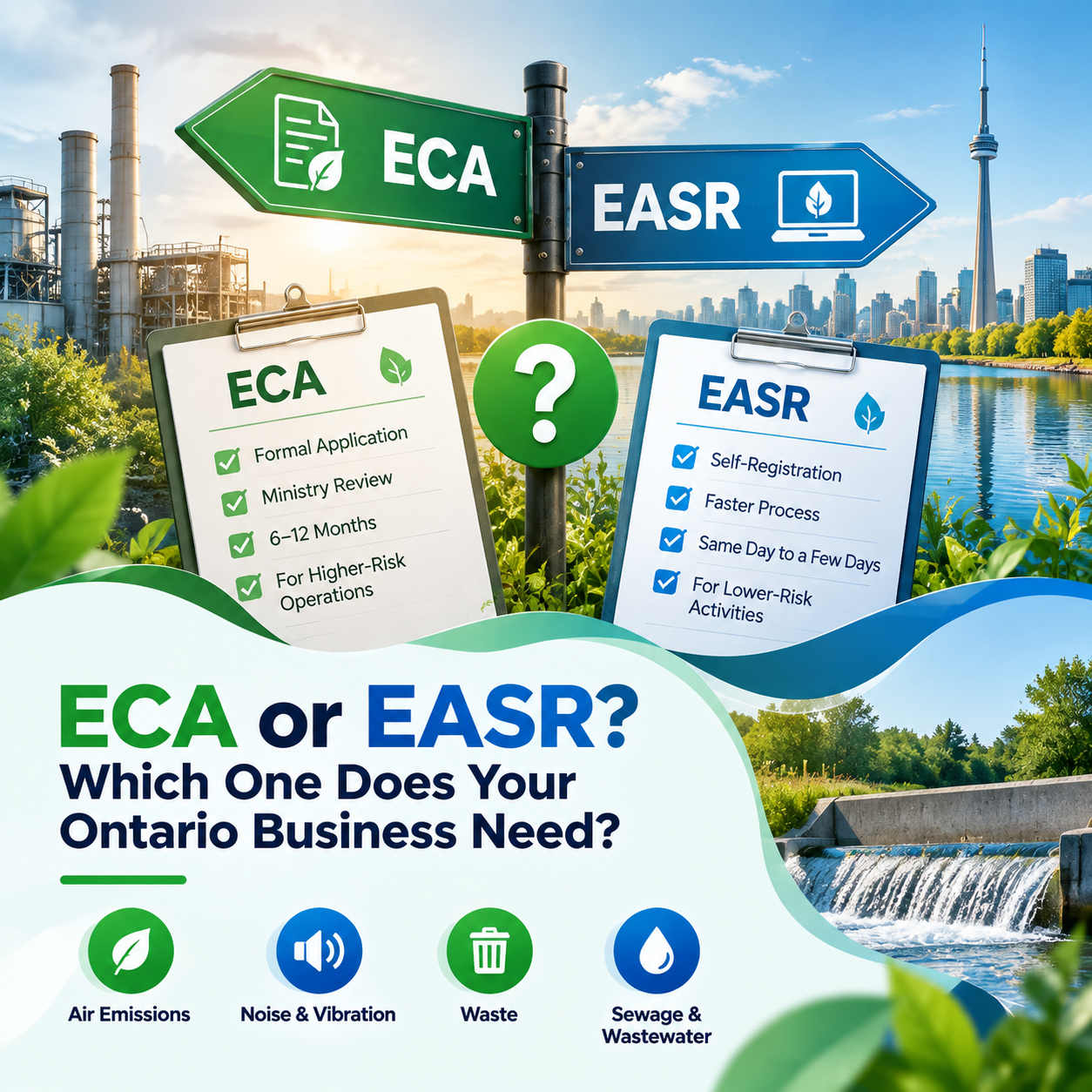
Whether you need an ECA for an auto body shop in Ontario depends mainly on whether the shop meets the criteria in Ontario Regulation 347/12. A shop that meets them registers in the Environmental Activity and Sector Registry (EASR) instead of applying for an ECA. The criteria cover the number of spray booths, the facility-wide coating application rate, whether the building is shared, how far the exhaust stacks sit from the property line, how far booth fans sit from nearby homes and other noise-sensitive uses, and where the wastewater goes. A facility that doesn’t meet them may need an air emissions EASR registration under Ontario Regulation 1/17 or an individual ECA.
Business size alone does not decide the answer. Your activities, equipment, emissions, building and site layout, and industry classification do. For a general overview of when ECAs apply beyond spray booths, including noise, waste and wastewater, see our plain-language guide to ECAs in Ontario.
Do I need an ECA for a spray booth in Ontario?
Not necessarily. Section 9(1) of the Environmental Protection Act (EPA) prohibits using, operating, constructing, altering or replacing equipment that may discharge a contaminant to air “except under and in accordance with an environmental compliance approval.” That prohibition doesn’t apply to activities that are prescribed for EASR registration (section 9(4)) or that fall under listed exceptions (section 9(3)). So the question isn’t whether your spray booth needs permission. It’s which kind.
For automotive refinishing, the EASR regulation is O. Reg. 347/12, . It defines automotive refinishing as applying coatings to, or repairing or customizing, a motor vehicle body or its parts, and repairing or customizing a vehicle’s interior. A facility qualifies for registration under this regulation only if it meets every criterion in section 2(2):
- Booths and coating rate in a building you fully occupy: at least one and no more than three spray booths, and a facility-wide coating application rate of no more than six litres per hour under normal operation.
- Booths and coating rate in a shared building: if the building has more than one unit and at least one is not occupied by your facility, only one spray booth and no more than two litres per hour.
- Stack distance to your property line: for each spray booth, the horizontal distance from the centre of its exhaust stack to the nearest point on your property boundary must be at least the distance set out in the regulation for your coating application rate.
- Fan distance to noise receptors: for booths served by indoor fans (measured from the exhaust stack) and for outdoor fans (measured from the fan), the distance to the property boundary of the nearest noise receptor must meet a minimum set by the number of booths. Alternatively, acoustic barriers with a density of at least 12 kg/m² must block the line of sight. Noise receptors include homes, hotels, long-term care and retirement homes, hospitals, campgrounds, child care and educational facilities, places of worship, and vacant lots zoned for these uses.
- Wastewater: any wastewater must go to an approved or registered waste management system, to sewage works covered by an ECA, or to a municipal sanitary sewer.
- Niagara Escarpment: in an area of development control, any required development permit must have been issued.
Section 2(4) says the regulation does not apply to a facility that:
- manufactures motor vehicles or motor vehicle parts,
- is primarily engaged in vehicle glass replacement and repair,
- is primarily engaged in mechanical or electrical repair,
- is a mobile refinishing facility, or
- controls spray booth emissions using water wash filtration.
In short, owning a spray booth doesn’t tell you whether you need an ECA. What decides it is how many booths you have, how much you spray, who shares your building, where your stacks and fans sit relative to your property line and your neighbours, where your wastewater goes, and the type of facility you run.

What a registered refinishing shop must do
Registration comes with operating requirements. Under section 4 of O. Reg. 347/12, these include:
- Coatings that meet the federal VOC Concentration Limits for Automotive Refinishing Products Regulations
- Spraying only inside a spray booth, and only between 7 a.m. and 7 p.m.
- High-volume, low-pressure (HVLP) spray guns with a manufacturer-stated minimum transfer efficiency of 65 per cent, electrostatic spraying equipment, or other equipment with manufacturer documentation showing at least 65 per cent transfer efficiency
- Booth filters rated by their manufacturer to remove at least 95 per cent of particles
- Vertical, unobstructed exhaust stacks that discharge at 12 metres per second or more and are at least 1.5 times the building height (with a limited exception for stacks covered by an ECA in effect on October 31, 2011)
- Exterior doors kept closed during sanding, grinding or buffing, except for normal entry and exit
- Training for the operator or manager and for coating personnel
- Notifying the MECP district manager of environmental complaints within two business days
Section 5 also requires records, including coating use (date, time, product and litres), inspections and maintenance, complaints, equipment specifications and training. Most of these records must be kept for five years.
Does a small auto body shop need environmental approval?
Generally, yes, if it sprays coatings. For many shops that permission is an EASR registration under O. Reg. 347/12 rather than an ECA.
Ontario lists automotive refinishing as one of the activities that can be registered in the EASR. Under section 20.21 of the EPA, nobody may engage in a prescribed activity unless they have registered it, received a confirmation of registration, and carry it out in accordance with the regulation.
- Older approvals: O. Reg. 347/12 set October 31, 2021 as the date on which an ECA issued for an activity covered by that regulation stopped applying to that activity (section 6, read with section 20.17 of the EPA). If your shop meets the O. Reg. 347/12 criteria and relies on an older approval (including a former Certificate of Approval), confirm its status with a qualified professional.
- Enforcement example: ES&E Magazine reported a 2016 case, citing an Ontario government news release, in which a Hamilton auto collision company and its director pleaded guilty under the EPA after ministry officers found an automotive paint spray booth that had not been registered in the EASR. The magazine reported fines of $6,000 for the company and $2,000 for the director, plus victim fine surcharges.
A shop that doesn’t meet the O. Reg. 347/12 criteria can’t rely on that regulation. Common examples are a fourth booth, a higher coating rate, a stack too close to the property line, or water wash filtration. Such a shop doesn’t automatically need an ECA. The next step is to check whether it is eligible for the air emissions EASR under O. Reg. 1/17 (see below) and, if not, whether an ECA is required.
Does a small manufacturing facility need an ECA?
Being small does not exempt a manufacturing facility. What matters is whether the facility has equipment or processes that may discharge contaminants to air, and which pathway applies to them.
Many such activities fall under the air emissions EASR, O. Reg. 1/17, . Section 2(1) of O. Reg. 1/17 covers the use, operation, construction, alteration, extension or replacement of equipment at a facility that may discharge a contaminant to air, as well as process or production-rate changes that may alter those discharges.
The air emissions EASR is not available to every facility. Under section 2(2) of O. Reg. 1/17, it doesn’t apply to:
- Facilities whose primary industry code is listed in the regulation’s Schedule. Industry codes come from the North American Industry Classification System (NAICS). Classes relevant to small manufacturers include chemical manufacturing (325), primary metal manufacturing (331), forging and stamping (3321), coating, engraving, cold and heat treating (33281), all other miscellaneous fabricated metal products (332999), rubber products (3262), urethane and other foam products (32615), and transportation equipment manufacturing (336).
- Facilities where certain activities take place, including plating that uses cadmium, cyanide, chromium or nickel; electrolytic stripping of those metals; processing metals outdoors, such as torching, shearing or plasma cutting (except routine maintenance); thermal treatment of waste; and combustion of biomass, coal, petroleum coke or waste fuels (with limited exceptions).
- Activities that are exempt from section 9(1) of the EPA.
Activities that can’t be registered in the EASR may need an ECA (Air emissions EASR user guide).
Shops outside the refinishing criteria: the Schedule doesn’t list automotive repair and maintenance codes (NAICS 811). The air emissions EASR may therefore be available to a refinishing facility that falls outside O. Reg. 347/12, unless another exclusion applies. This depends on the facility’s specifics, so have a licensed engineering practitioner confirm it as part of an ECA and EASR eligibility screening.
Facilities with more than one EASR activity: section 3 of O. Reg. 1/17 sets out what happens when a facility has activities prescribed under both the air emissions EASR and another EASR regulation, such as automotive refinishing. The air emissions EASR generally applies to all of them. The other regulation continues to apply only if all of the facility’s air-emitting activities are prescribed under that single other regulation, or are exempt from section 9(1).
What is the difference between an ECA and EASR registration?
An ECA is an individual approval. You apply for an Environmental Compliance Approval through the MECP, the ministry reviews your application and supporting reports, and if it approves, it issues an approval with conditions specific to your facility. Application fees vary by activity and the reason for the application. The ministry’s service standard for most ECA applications is one year.
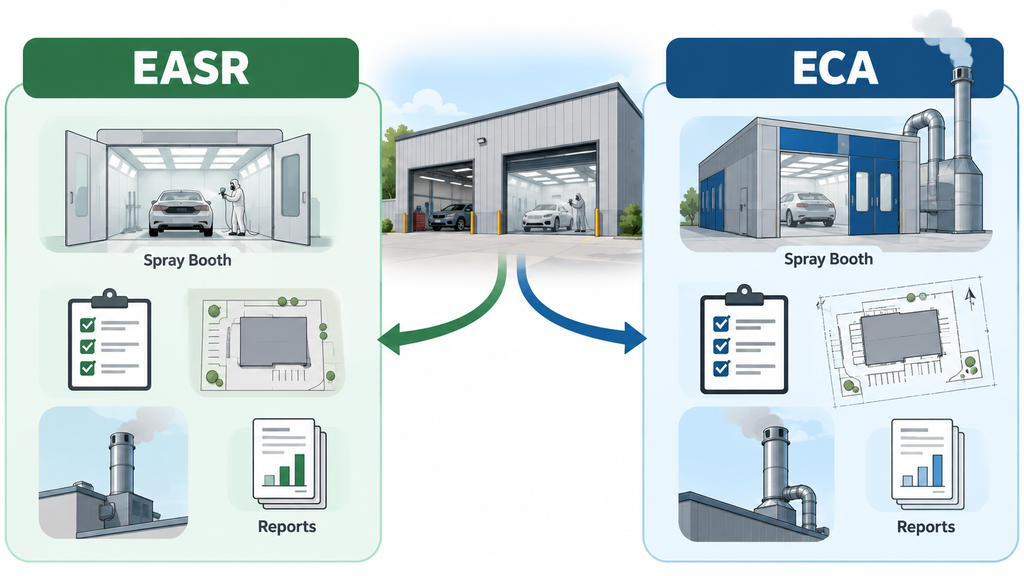
EASR registration is online self-registration for prescribed activities that meet the eligibility rules in a specific regulation. You must then carry out the activity in accordance with that regulation. Ontario states that your electronic confirmation of registration “is required before starting or continuing your activity.” It also states, “There are no fees for registering EASR activities” (Ontario: EASR, updated October 5, 2026).
EASR registration doesn’t mean less work. For the air emissions EASR, a facility must have reports prepared before registering, including an Emission Summary and Dispersion Modelling (ESDM) report and a noise report. SONAIR’s acoustic assessment report page explains how facility noise is modelled at nearby receptors and compared with ministry limits. Most of these reports must be signed and sealed by a licensed engineering practitioner (LEP), meaning a person licensed under Ontario’s Professional Engineers Act (Air emissions EASR user guide). The automotive refinishing EASR instead sets its own criteria, operating rules and record-keeping requirements in O. Reg. 347/12.
| ECA | EASR registration | Needs further assessment | |
| What it is | Individual approval issued by the MECP after review | Online self-registration for prescribed activities | Facility does not clearly fit either pathway |
| Who uses it | Activities that are not exempt and not prescribed for the EASR | Activities that meet a specific EASR regulation (e.g. O. Reg. 347/12 automotive refinishing, O. Reg. 1/17 air emissions) | Mixed operations, a NAICS class listed in the O. Reg. 1/17 Schedule, criteria near the limits, or possible exemptions |
| Ministry review before operating | Yes. One-year service standard for most applications | No individual review. Confirmation of registration is required before the activity starts or continues | Depends on the outcome |
| Fees | Vary by activity and application type | Ontario’s EASR page states there are none | Depends on the outcome |
| Ongoing obligations | Conditions written into the approval | Operating and record-keeping rules set by the regulation | Depends on the outcome |
| Technical work | Supporting reports, such as an ESDM report and noise assessment, as required | Air emissions EASR: LEP-sealed reports before registration. Automotive refinishing EASR: meet the criteria and operating rules in O. Reg. 347/12 | Facility information is needed to decide which applies |
When an activity is registered in the EASR, any ECA for that activity at the site stops applying to it as of the date set out in the confirmation of registration (EPA, section 20.17).
Existing air ECAs and January 31, 2027: section 4 of O. Reg. 1/17 sets January 31, 2027 as the date on which an ECA issued for an activity prescribed by O. Reg. 1/17 stops applying to that activity. Under section 5, a facility that registers before that date while an ECA is in effect must register all of its O. Reg. 1/17 activities at the facility. The MECP user guide also says registration is needed before any modification that would require an ECA amendment, if that comes first. This date applies to air emissions EASR activities. Automotive refinishing activities covered by O. Reg. 347/12 had an earlier date (October 31, 2021, as noted above). If you hold an air ECA, check whether this deadline affects you.
What information determines whether a spray booth needs approval?
Legal criteria are the facts the regulations themselves use to decide which pathway applies:
- The type of facility and activity, including whether O. Reg. 347/12 excludes it (vehicle or parts manufacturing, glass or mechanical repair as the primary business, mobile refinishing, water wash filtration)
- The number of spray booths
- The facility-wide coating application rate under normal operation
- Whether the facility occupies the whole building or shares it with other units
- The horizontal distance from each exhaust stack to your property boundary
- The location of booth fans (indoor or outdoor), the distance to the nearest noise receptor’s property, and any acoustic barriers
- Where wastewater is discharged
- The facility’s primary NAICS code and any activities that O. Reg. 1/17 excludes
- Whether an activity is exempt under section 9(3) of the EPA or O. Reg. 524/98. O. Reg. 524/98 does not refer to spray painting or coating by name, so any exemption question needs a facility-specific review.
Supporting information does not decide the pathway on its own, but a consultant or engineer needs it to apply the criteria accurately:
- Spray booth make, model and design specifications
- Coating, primer, clear coat and solvent safety data sheets and usage records
- Spray gun type and manufacturer-stated transfer efficiency
- Exhaust fan and stack locations, heights and flow rates
- A site plan showing property boundaries and nearby homes or other sensitive uses
- Other equipment that emits to air, such as heaters, curing ovens, dust collectors or welding
How to check your environmental approval requirements
- List every operation that may emit to air. Include spraying, sanding, curing, cleaning, heating and any manufacturing processes.
- Document your spray booths and other equipment. Record the number of booths, their specifications, filtration type, fan locations and exhaust stacks.
- Gather coating and solvent information. Collect safety data sheets and purchase or usage records so the coating application rate can be estimated.
- Map exhaust points and neighbours. Mark every stack and fan on a site plan, then measure the distance to your property line and to the nearest noise receptor’s property.
- Confirm your building and wastewater situation. Note whether you share the building, and where floor drains or wash water discharge.
- Review the applicable Ontario requirements. Compare your facility against O. Reg. 347/12, O. Reg. 1/17 (including its NAICS Schedule and excluded activities) and the section 9 exemptions.
- Confirm the pathway. Determine whether an EASR registration, an ECA, an exemption or another requirement applies.
- Complete the registration or obtain the approval before you start. For the EASR, Ontario requires confirmation of registration before the activity starts or continues. For an ECA, you need the approval before carrying out the activity it covers.
What should I do before installing a new paint booth?
Check your requirements before you buy or install the booth, not after. A new booth can change your booth count, coating rate, stack and fan locations, and noise exposure for neighbours. Any of these can move your facility outside the O. Reg. 347/12 criteria.
O. Reg. 347/12 covers constructing, altering or replacing refinishing equipment and changing processes or production rates. Section 3 exempts some activities at an already-registered facility from re-registering, but the facility must still meet the regulation’s criteria and requirements.
If an ECA turns out to be required, build the ministry’s one-year service standard for most applications into your project schedule.
What happens if I operate equipment without a required approval?
Operating equipment that requires an ECA without one breaches section 9(1) of the EPA. Engaging in a prescribed activity without a valid EASR registration, or without following the regulation’s requirements, breaches section 20.21(1). In the 2016 Hamilton case reported by ES&E Magazine, ministry officers found an unregistered paint spray booth during an inspection and referred the matter to the ministry’s Investigation and Enforcement Branch. Both the company and its director were convicted and fined.
Outcomes depend on the facts of each case. That reported conviction shows the requirement has been enforced against a small shop and that a director was personally convicted. It does not predict what any particular business would face.
Are there other environmental requirements for auto body shops?
Yes. The federal (SOR/2009-197) set VOC limits for automotive refinishing products. O. Reg. 347/12 requires registered shops to use coatings that meet them. Depending on your operations, you may also need to address waste and wastewater requirements, sewer use, and municipal, building and fire code requirements. Those are outside the scope of this article.
When should I consult an environmental compliance specialist?
Consider professional help when:
- Your facility is near or over any O. Reg. 347/12 limit, or is close to homes or other noise receptors
- You share a building with other tenants
- You use water wash filtration, or run both refinishing and other manufacturing or coating processes
- You are unsure of your primary NAICS code or whether an exemption applies
- You are adding a booth, changing coatings or increasing production
- You hold an older air approval and need to know whether it still applies, or whether the January 31, 2027 date affects you
- Your pathway requires LEP-sealed reports, such as an ESDM report or a noise report
How SONAIR can help
SONAIR Environmental Inc. is an Ontario environmental consulting firm that helps businesses with Environmental Compliance Approvals and ECA and EASR screening and registration. For facilities that emit to air, SONAIR prepares Emission Summary and Dispersion Modelling (ESDM) reports and Acoustic Assessment Reports, and serves industrial facilities across Ontario.
If you aren’t sure whether your auto body shop or small manufacturing facility needs an ECA, an EASR registration or neither, SONAIR can review your operations, equipment and site information and explain which requirements are likely to apply. The ministry, not a consultant, decides ECA applications.
Have questions about a spray booth or a planned expansion? Book a consultation with SONAIR, or call (437) 733-2880.
Frequently asked questions
Not always. An automotive refinishing facility that meets the O. Reg. 347/12 criteria registers in the EASR instead of applying for an ECA. The criteria cover booth count, coating application rate, building occupancy, stack distance to the property line, fan distance to nearby noise receptors, and wastewater. A facility that doesn’t meet them may be eligible for the air emissions EASR under O. Reg. 1/17 or may need an ECA.
No. Many auto body shops that spray coatings need an EASR registration rather than an ECA. Which one applies depends on the shop’s spray booths, coating rate, building, site layout, neighbours, wastewater and any other air-emitting activities.
Size alone does not create an exemption. Specific activities may be exempt under section 9(3) of the EPA or O. Reg. 524/98. Others may be eligible for the air emissions EASR, unless the facility’s primary NAICS code is listed in the O. Reg. 1/17 Schedule or it carries out an excluded activity, such as certain plating processes.
No. An ECA is an individual approval issued after ministry review. EASR registration is online self-registration for prescribed activities that meet a regulation’s eligibility criteria, followed by compliance with that regulation’s operating rules. Both are forms of environmental permission.
Yes. A new or replacement booth can change your booth count, coating rate, stack and fan locations, and distances to neighbours, and any of these can change your pathway. EASR confirmation is required before the activity starts, and most ECA applications have a one-year service standard.
Prepare a list of operations, spray booth and filtration specifications, coating and solvent safety data sheets and usage records, spray gun details, stack and fan locations, a site plan showing property boundaries and nearby homes, wastewater discharge details, information about other tenants in the building, and copies of any existing ECAs or EASR confirmations.